

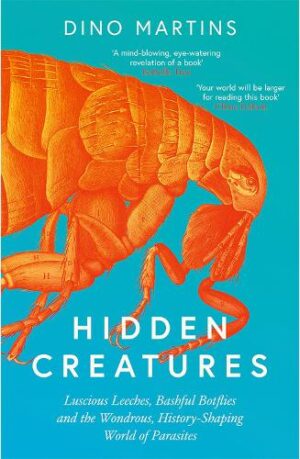
One of our favourite books of the year to date, Hidden Creatures by Dino Martins takes us on a journey into the enigmatic world of parasites. These unsettling critters are camping out on practically every square inch of our planet, frolicking in our intestines, gorging on our blood and nibbling away at our animals. We join Dr Martins, often in the company of his eager students, crossing continents and studying them at depth, from the tiniest tick to the largest parasitic worm. Filled with both gloriously poetic descriptions of the natural world and thrillingly repulsive accounts of parasite behaviour, it’s a unique and fascinating read.
Martins’ career as an entomologist and evolutionary biologist was inspired by a childhood observation of wasps inhabiting a caterpillar’s body. Amazingly, there were even tinier wasps parasitically feeding on the original wasps. As Martins puts it, ‘Wasps eating wasps within a caterpillar!’. This revelation of life within life sparked his curiosity, purpose, and many years of groundbreaking research.
He begins with parasitic worms, the likes of roundworm, tapeworm and lungworm, which are commonly recognised. But have you heard of eye-worms that migrate through the surface of the eyeball? Or the ‘extremely gross’ behaviour of the guinea worm? This is the largest parasitic worm, able to grow to almost a metre in length and prone to emerging from the skin of its host’s body in a slow, festering and agonising process. It’s a blessing that there are no accompanying photographs.
From worms we proceed to maggots, and the ‘shimmering, stinking’ scene of an elephant’s death. Here, Martins’ descriptive talents come to the fore as he tells us about the maggots feasting on the elephant’s corpse, the rasping hum of their mouths ‘scraping and slurping’.
‘Squelching, they display the rudest of health and shimmer within a rainbow patina of digestive juices’.
Whilst colourfully recounting this grotesque scene, Martins is keen to champion maggots for their ecological and medical uses and gives some interesting insights into their invaluable role in our world.
No such plaudits for mosquitoes, whose history he relates as inflicting so much damage on human lives and bringing empires to their knees. His thoughts on these ‘flying syringes’ range from malarial Africa to the unexpected environs of Holland Park in west London, where blackbird numbers have plummeted, due to mosquitoes spreading the lethal Usutu virus.
Ticks and lice are more familiar to us (particularly the head-roaming type, as exasperated parents everywhere can attest to). But it’s bedbugs that raise eyebrows here. Martins informs us that they live for two things: food and sex. Steel yourself for his description of their mating ritual, potentially coming to a mattress near you (up to 80% of hotels in some cities are reporting bedbugs at least once a year).
Vivid, engaging and endlessly informative, Hidden Creatures is also filled with beautiful descriptions of the landscapes Martins loves; silhouettes of giraffes against wide skies, golden dawns and horse riding across the savanna.
We are all one, Martins tells us, inextricably linked, ‘one global family’. A magnet for the parasites, who do not recognise international borders, only their next meal.
A wonderful read.
Hidden Creatures by Dino Martins is published by William Collins, 336 pages.