


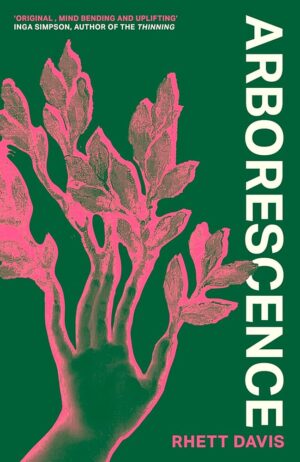
Bren and Caelyn are a twenty-something Australian couple, whose lives are somewhat adrift; Bren employed in a nebulous role in the content industry, Caelyn flitting between jobs, dissatisfied and searching for purpose. A random viewing of a surreal, so-called ‘tree cult’ video pricks her curiosity and the couple embark on an investigative journey into the startling rise of environmentalist groups whose members believe that if they stand still for long enough, they will take root and become trees. In the uniquely compelling Arborescence by Rhett Davis we watch as old-school tree-hugging morphs into a practice whose logic and finality becomes strangely infectious.
The couple’s first encounter with the phenomenon comes from video footage that Bren’s brother shares with them. Maybe thirty people, just standing in a field, facing the sun. The footage runs for three hours and no one moves. Bemused, they initially put it down to ‘wacky’ performance art, hipsters and hippies. But over time there is corresponding footage from other locations and anecdotal evidence. Whether it’s collective delusion, mental illness or cult, Caelyn wants to find answers.
At last she has found her calling, deciding to write an investigative article and then a PHD thesis. By now believing that at least some of these people have literally become trees, Caelyn is facing open mockery and accusations of ‘misguided anthropology’ and outright fiction. She needs to find solid evidence, and in one bone-chilling scene, Bren examines an oddly pallid oak tree where the ground beneath it does not correspond with the age of the tree, ‘no debris or grass or bed of leaves’.
‘I pick up an acorn and inspect it. It’s pale green and the seed gives a little when I squeeze it. A little too much. It’s not fleshy, but it doesn’t quite feel like an acorn either. As if it were created too quickly to accumulate its usual density.’
Arborescence is a gloriously strange novel, described by Davis as a tale of ecological grief. Human beings have plundered and toxified the planet, now it seems as if some of them, in repentance, or as a bizarre means of extending their own life span without causing further harm, have decided to metamorphose into trees, to surrender themselves to what Caelyn comes to consider the highest form of life.
In the beginning, mostly they are older people. Perhaps having lived full human lives, they’re selfishly hoping to expand their existence. But as the phenomenon of arboromorphism spreads, it’s younger people, even children, ‘like delicate saplings waving in the breeze’, renouncing their humanity.
Davis sets the story in a near-future where AI is running much of the corporate world behind the scenes, whilst still employing humans as its public face (Bren’s obscure job role is a prime example). There is a sinister sense of the imminent severing of the symbiotic relationship between AI and humans. It will finally sustain itself. In such a scenario, is it any wonder that even the young are withdrawing from human society, abandoning humanity as it appears to be in terminal decline?
A novel that gives much food for thought, Arborescence is an inspired story of both loss and hope. A must-read.
Arborescence by Rhett Davis is published by Fleet, 304 pages.