

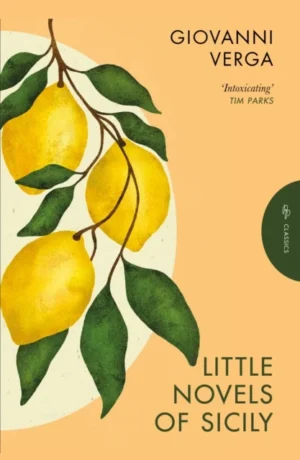
At first glance, the striking cover of Little Novels of Sicily by Giovanni Verga appears to suggest sunshine, lemon groves, perhaps a dash of heartwarming whimsy. But Verga’s Sicily was a 19th-century island of grinding poverty, widespread corruption and disease. In these dozen short stories, first published in 1883, the author draws inspiration from the villages and people of his youth. Each tale is touched with the beauty of the landscape but has a sting in the tail, as clergy, landowners and peasants variously thrive, struggle, revolt, and often succumb to malaria in this superb collection, translated by none other than D. H. Lawrence in 1925 and republished by Pushkin Press Classics.
One of several stand-out stories, Malaria is set amongst the scattered villages that sit on the plains by the Lake of Lentini. Malaria was prevalent in Sicily during the 1800s, and with some wonderfully evocative writing, Verga captures the feelings of a community in dread and the sense of the disease as a lurking, malevolent presence. Almost tangible, malaria smokes up from the earth; On the railway track that crosses the plain, trains puff through it. As it has its wicked way with the locals, one bitter widower stands by the signal box, watching the railway carriages sliding past, filled with passengers heading for healthier climes. He sees the beautiful ladies, ‘the silver and the tarnished steel of the bags and valises that shone under the polished lamps’, and he understands that ‘…for that lot there isn’t any malaria’.
This concept of them and us recurs throughout the book. In Story of the Saint Joseph’s Ass, it rears its head in a desperately sad allegorical tale about the hard life of a little donkey. Worked to the bone and perpetually exhausted, he is sold down the line for less and less money, his string of owners indifferent to his fate (Verga’s blistering take on the exploitation of the Sicilian working classes).
His Reverence spins the ‘them and us’ theme to chart one man’s rise from poverty to priesthood and how personal greed warps his soul and turns his heart against his people. This is a man for whom charity certainly does begin at home, as he uses information gleaned from church-goers’ revelations in the confession box to gain property and influence (if he falls into mortal sin in the process, he can always grant himself absolution).
His fortunes begin to change however, as society progresses. Peasants are learning to read and write and the rise of newspapers means that the judiciary and the police fear public opinion and accountability.
These ideas coalesce in one of the final tales, Liberty, inspired by the Sicilian Revolution of 1860. Here, the masses rise up, ‘a sea of white stocking-caps, axes and sickles glittering’. They rage against the baron, the priest, and the police sergeant, ‘You’re not going to escape, no matter how fat you are with the blood of the poor’.
But what is it they expect from this supposed emancipation and what will be the consequences of so much violence?
Laced with irony and conviction, Verga gives us a fascinating fictional portrait of Sicily long before it became a premier holiday destination.
Little Novels of Sicily by Giovanni Verga is translated by D.H. Lawrence and published Pushkin Press Classics, 176 pages.