


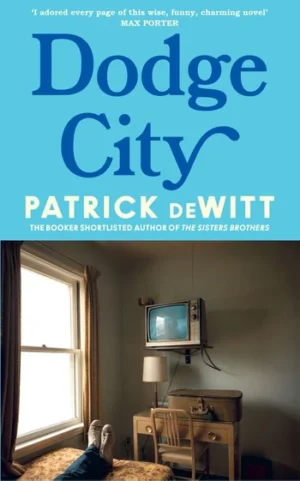
California, 1967, a place of increasing public protest against the ongoing Vietnam War and the escalation of U.S involvement. Here we meet Lee Clarke, a small-town boy from Washington State, ejected from his course at UCLA after a violent altercation. His draft deferment is subsequently cancelled and the stricken Lee, unable to face the prospect of military service in Vietnam, decides that his only option is to escape to Canada. In a wry examination of patriotism, American masculinity and counterculture, Dodge City by Patrick DeWitt, sends Lee on an amphetamine-powered road trip, as he drops in on a clutch of eccentric family members en route to his new life.
Lee first arrives in California seeking an escape from the ‘permanent gray ceiling’ of his home town. As the unworldly product of a 1950s provincial childhood, Lee realises on day one at UCLA that he’s out of his depth. By week three, he’s hooked up with a perma-stoned, barefoot bohemian named Cal, who introduces him to the concepts of free love, drug taking, and new freedoms. For her part, Cal is a little disappointed in her attraction to Lee and his old-school masculinity. She wonders if she’s ’succumbed to the antique figurehead’.
But for all his apparent squareness, Lee has a hitherto untapped streak of rebellion and the day he visits the draft office after an unfortunate bust-up with one of Cal’s nihilistic friends, it comes to the fore. The righteous nationalism of a framed lithograph of a patriotic eagle bearing the legend ‘To a man, free’, leaves him feeling that he has entered a ‘lunatic reality’. One that he wants no part of. A fast car, a bag of uppers and the open road calls to him.
De Witt writes here with his customary wit, perception, and vividly drawn characters. He captures the zeitgeist of late 1960s America, and the chasm between generations and life expectations, particularly in respect to attitudes towards the Vietnam War.
Lee’s hinted at family issues come to the fore as he interrupts his road trip periodically to drop in on dysfunctional siblings, estranged parents and uncle. Each of them have firm opinions on his draft dodging escapade.
In a key scene, Lee’s veteran father tells him that conscientious objection was almost unheard of in his day, ‘That’s your generation’s contribution to the culture’. Lee’s response that it’s bizarre to expect men to head to foreign shores to murder strangers is met with a blunt response. His father declares that he paid his way in World War Two, in order to be able to hold his head up high in the USA.
‘The war they give you, that’s your war…It’s just a part of the male American experience. And if you leave your country…you’ll be losing a piece of yourself you won’t get back’.
A later conversation with his uncle gives Lee a painful alternative perspective to consider, whilst his mother’s pronouncement that the spirit of the time is unrecognisable to her resonates alongside the unfolding family story.
And Lee motors towards Canada, running out of drugs but curiously calm.
If you enjoy this excellent new novel, see also our review of The Librarianist by Patrick DeWitt.
Dodge City by Patrick DeWitt is published by Fourth Estate, 246 pages.