

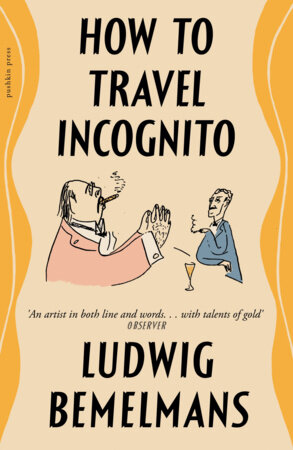
It’s the early 1950s in Paris, the bruises of wartime are fading, the city is once again fashionable and the Americans are back in town, flashing their cash. In the witty fictionalised memoir, How to Travel Incognito by Ludwig Bemelmans, Bemelmans tells the tale of an extraordinary vacation spent in the company of the charismatic but virtually destitute Count of St. Cucuface. Persuading Bemelmans to adopt the identity of a German prince, St. Cucuface leads him on a French adventure and a grand scam, instructing his new friend on how best to adopt a lavish lifestyle whilst, in fact, not having two francs to rub together.
In real life, Bemelmans was the writer and illustrator of the classic Madeline children’s books, already famous when How to Travel Incognito was published in 1952. His reason for writing it is encapsulated in the book’s dedication to a friend who had asked him to ‘write something amusing, to cheer up the sorry (postwar) world’.
Amusing it certainly is, and accompanied by Bemelmans’ trademark playful illustrations, begins in Chapter One with an ink drawing of a sleeping gentleman in the first-class carriage of a train. The man is St. Cucuface, observed by fellow passenger, Bemelmans. He is distinctive, tall with folded long legs, reminiscent of a leggy marsh bird. At the next station, he suddenly leaps up and exits the carriage at speed.
Not long afterwards, sheer coincidence sees Bemelmans encountering St. Cucuface at a cocktail party and being amazed that the man remembers him when he’d appeared to be sound asleep. This is where it all begins, when St. Cucuface confesses that he’d been alert the whole time.
‘There is a law in France that no First Class passenger asleep may be awakened by a conductor…Considering that we are a republic we have more regard for privilege than any other nation on earth’.
For while St. Cucuface has no money for train tickets, he has a gift for using his aristocratic bearing to maximum effect. Perhaps Bemelmans would care to assume the identity of the Prince of Bavaria and join him in his freeloading escapades?
Thus Bemelmans finds himself seduced by a world of escargots, steaks and fine wines, the best tables in restaurants and a welcome at a cocktail party hosted by the Aga Khan. By the time St. Cucuface suggests they drive a friend’s Rolls-Royce convertible to Cannes, Bemelmans is fully versed in the art of imposture. He looks forward to more of the same, on a trip peppered with St. Cucuface’s anecdotes about his upper crust family and a bizarre stay with his Aunt Eulalia, who the Count describes with untypical understatement as ‘a little odd’.
In a novel of fine description Bemelmans’ words on Paris are particularly evocative. On his first visit to the Count’s apartment one full-mooned evening, Bemelmans’ view from the balcony is romantic; the Eiffel Tower, Notre Dame, Montmartre in the distance. All that is most beautiful in Paris under a sky shaded blue and violet, in the manner of artist, Raoul Dufy.
An elegant and entertaining portrait of French high-society in post-war flux.
How to Travel Incognito by Ludwig Bemelmans is published by Pushkin Press, 224 pages.