

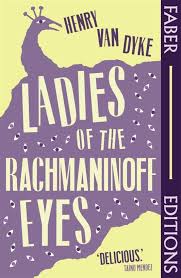
We’re devotees of the excellent Faber Editions series, dedicated to resurrecting radical novels of the 20th century. New to the list is an American gem, Ladies of the Rachmaninoff Eyes by Henry Van Dyke. This distinctly offbeat 1950s-set drama is told through the eyes of Oliver, a young, gay Black man, who lives with his elderly aunt, Harriet, and her employer of thirty years , Mrs Etta Klein. In a tale that ranges from farce to tragedy (with lashings of rum), Oliver uncovers the truth behind a Klein family suicide, in the company of a sex-mad maid, a shady psychic, and his own beloved volume of Baudelaire’s poems.
The novel begins, shockingly, with Aunt Harriet’s death. She lies dead in the garden with Mrs Klein weeping over her body, ‘She did it to spite me Oliver…’.
As Oliver stands with ‘the fact of her death’ at his feet, his mind replays the events that have culminated in the loss of his last living relative, the incessant bickering, weeping and reconciling that characterised the old ladies’ relationship. Ostensibly Harriet had been the housekeeper for wealthy Jewish widow Klein but theirs was an odd companionship, veering between, say, an argument over Mrs Klein’s penchant for rum, to misty-eyed reminiscing over their years spent living in New York. Often to be found weeping into their lace handkerchiefs over something or other, Oliver can cope with the ladies’ lesser dramas but one recurring subject disturbs him: the suicide some years before of Mrs Klein’s son, Sargeant, found in a bathtub with his wrists slashed, leaving no note.
Now, as Oliver’s story unfolds, we learn how Sargeant’s death has led indirectly to Aunt Harriet’s own demise: a recent magazine advert offering the services of one Maurice LeFleur, a ‘psychic warlock’, who Mrs Klein, desperate to know why her son took his life, invites to conduct a seánce, on the weekend that changes everything.
This is such a cleverly unpredictable read. On the one hand, theatrical and witty, its characters exaggerated (more than one ‘seductress’, a ‘mentally disturbed’ peacock, the ludicrous LeFleur with his Hitler hairstyle and expertise in astrology). Yet there are undercurrents; the novel is set shortly before the civil rights transformations of the 1960’s, racism simmers below the surface and homosexuality is initially only alluded to (gentle Oliver with his English Tweeds and well-worn copy of Les Fleurs du Mals, another male character referred to as a ‘bachelor’).
In the days leading up to the séance, Oliver considers his own role in this eccentric household, how Mrs Klein’s patronage has given him an education, made a ‘project’ out of him. Della, the maid, scoffs at how ‘Old Etta Klein’s trying to make a white boy out of you’. And a surrogate son? What spectres may be raised at LeFleur’s candlelit gathering?
A unique and memorable novel, Ladies of the Rachmaninoff Eyes is filled with comedic moments and vivid characters but the poignant final chapters may bring a tear to the eye, reminiscent of Oliver’s lachrymose ladies, whose tears ‘coming out of their ancient eyes’, wetting their ‘millions of wrinkles’ remind him of old photos of famously tortured composer, Sergei Rachmaninoff.
Ladies of the Rachmaninoff Eyes by Henry Van Dyke is published by Faber & Faber, 192 pages.