


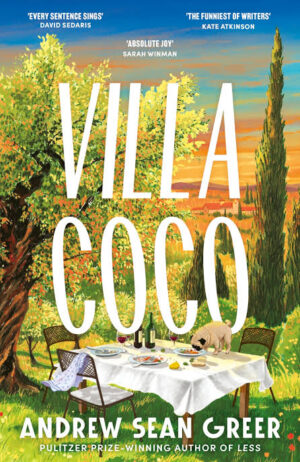
Happily destined for the Summer Reads bestseller lists, Villa Coco by Andrew Sean Greer seems at first glance to follow the well-worn literary path of an American innocent abroad. It tells the story of an initially unnamed young man, a recently graduated archivist, hired to catalogue the artefacts and treasures of a grand Tuscan Villa. Upon arrival, however, he is plunged into a world of bizarre characters and strange events orchestrated by his employer, 92-year-old Coco, the Baronessa. Coco instantly nicknames him ‘Giovedì’, and along with her kooky companions, lights his way to a life well lived in Greer’s luminous tale of friendship, abiding secrets and sheer zest for life.
The story is told retrospectively by an older, wiser Giovedi. It begins with his arrival in the Tuscan hills on a sun-kissed September day, resolved to embark upon a ‘serious’ life after his carousing university days and somewhat pompously declaring that he will enter ‘the cloister of my work, my mind, and tend the garden there’.
Shortly after arriving at Villa Coco, with its olive groves and interiors overflowing with art pieces and curios, Giovedi encounters Coco for the first time. Greer introduces her in a fabulously camp scene, gradually descending a staircase with pet pugs in tow.
‘There arrived, long before the personage herself, like the scent that heralds a storm’s arrival, a cloud of dense Italian language flowing down the stairs…a white cotton slipper…lacy hem…a papery hand gripping the railing’.
Coco, the Baronessa is a livewire, ‘barely’ into her nineties. She once hobnobbed with Man Ray and Salvado Dali (who tickled her ear with his moustache). Mick Jagger has been a houseguest. Not only has Coco lived one hell of a life, she’s a woman on a mission and Giovedi’s now on hand to help her.
At times gloriously silly, Villa Coco is a great escapist holiday read. Greer delivers plenty of Italian delights; crazy driving on hairpin roads, Lambrusco, laughter, and the freshest olive oil. Guests come and go and Giovedi is expected to entertain (other duties include pruning bushes and dealing with a malfunctioning septic tank). As yet, there has been little mention of archiving.
As time passes, a bemused Giovedi begins to realise that things are not as they seem. Guests have secrets, things have been going missing. There is the odd sensation that the house is dwindling. ‘As if some enchantment had reached its limit.’
The frustrated archivist is about to realise that he had the story of Villa Coco all wrong. Beneath the carelessly extravagant bohemian exterior, there is plotting, subterfuge, and a potential supporting player role for himself.
Greer has said in interviews that he envisaged Villa Coco as a ‘charm novel’, the kind of story that may encompass serious aspects of life and the world but has lightness, laughter, and ‘sunlight to the characters’. In this unpredictable and eccentric tale, he has surely succeeded.
If you like this, see also our review for Less by Andrew Sean Greer, winner of the Pulitzer Prize for Fiction in 2018.