


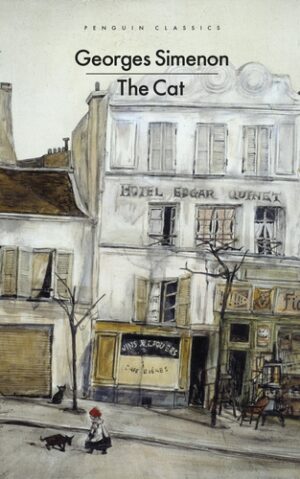
First published in 1967 and now available in a freshly translated Penguin Classics edition, The Cat by Georges Simenon is a bleakly funny tale of marital warfare, old age and obsession. Celebrated for his wonderful Inspector Maigret novels, Simenon also wrote a series of psychological novels he named ‘romans dur’ (hard novels). In this one, we meet seventy-somethings, Emile and Marguerite Bouin, married in haste and repenting at leisure. Since Emile accused his wife of fatally poisoning his beloved cat and launched a barbarous retaliatory attack on her pet parrot, they have been enmeshed in a silent battle of wills. Will it be a duel to the death?
Time passes desperately slowly in the Bouin household. A typical afternoon would find them both sitting by the fireside, together but alone, Emile covertly eyeing Marguerite over his newspaper, the click of her knitting needles in tandem with the hands of the mantel clock.
Emile keeps a small notebook upon his person. Often he will tear out a page, deliberate over it with a pencil, write a message, fold it up very small, ‘as children do with a pellet they shoot from an elastic band’, roll it between his thumb and fingers, and flick it at Marguerite. His messages vary in dramatic content, but the one that crops up most frequently consists of just two words, ‘The cat’.
On days when the dead cat is thus evoked, Marguerite will stand and walk pointedly across the room to her birdcage. Her precious parrot may be similarly expired but its taxidermied body stares through the bars with accusing glassy eyes. Emile is set to discover that a wronged woman will always have the final word.
In this dark, claustrophobic tale, Simenon brilliantly cranks up an atmosphere of extreme paranoia. Neither spouse trusts the other to cook for them, so they cook separately, keeping their food under lock and key. Not wanting to relinquish the best bedroom, Emile instead buys a separate bed and puts it next to Marguerite’s. She hangs a portrait of her first husband above the bed, Emile responds with one of his own late first wife. Beneath these paintings, the pair undress each night, sneaking mocking glances at each other’s sagging physiques.
This grotesquely comic saga unfolds against a Parisian neighbourhood in flux. Property developers are in the process of demolishing a row of houses opposite and the Bouin’s daily trials take place against a cacophony of wrecking balls, diggers and bulldozers, a brutal mirror to their own disintegrating relationship.
The question of what has gone so disastrously awry in their marriage is picked over by Emile, in his ruminations on the past. They always seemed an unlikely couple, the delicate, opera loving Marguerite and this somewhat oafish, heavy-footed man with his smelly cigars. Each day finds Emile self-medicating with increasing amounts of red wine, vanishing into memories and wondering what price freedom. The inscrutable Marguerite has her own ideas.
Fans of this fabulously intense domestic drama should check out the 1971 film, Le Chat, starring Simone Signoret and Jean Gabin, and based on Simenon’s novel.
The Cat by Georges Simenon is translated by Ros Schwartz and published by Penguin Classics, 160 pages.