


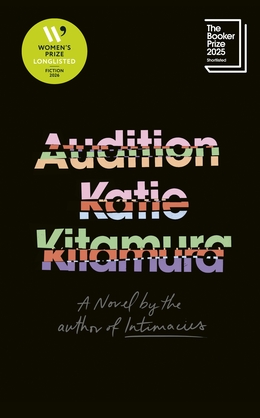
Previously Booker Prize shortlisted and now comfortably nestled on the Women’s Prize 2026 longlist, Audition by Katie Kitamura is a tantalisingly oblique read. Exploring the roles we play in life, their often performative nature and how others interpret them, the story centres on an unnamed middle aged woman and a young man. The woman is a successful actress, currently appearing on stage in New York, the young man may well be her lover. Or her son. Perhaps he’s actually an invention. A novel for those who love a challenge, from a writer adept at wrong-footing and disorienting her readers.
Presented in two parts (or acts), the story begins in a restaurant, where our narrator is meeting an attractive young man named Xavier for lunch. Their waiter’s professional mask of neutrality slips as he notes the narrator’s well-heeled appearance and the disparity in their ages. She knows he has made an assumption about the nature of their relationship.
Xavier himself is nervy, he has something he wants to say. As he leans back in his chair and exhales, the actress realises that he’s copying one of her acting mannerisms, ‘an old gesture of mine…lifted from my films, my stage performances and copied without shame. A piece of me, on the body of a stranger…’
Her assertion that he’s a stranger will be challenged when this scene is revisited in part two of the novel, only this time the narrator’s husband, Tomas, is also at the table, and Xavier is their son.
In Kitamura’s coolly insightful story, the reader has work to do, juggling different versions of events, and deciphering the shifting, contradictory portrayals of both Xavier and Tomas. Early on in the proceedings, Tomas is a calm, introspective figure, supportive of his increasingly anxious wife. One half of a career-minded child-free couple, later to be a seemingly concerned father, and then something more unsettling altogether, each role redefining his external relationships.
Against this backdrop of shifting realities, the actress is in rehearsal for a new play, and initially struggling with her role, unable to fully immerse herself in it. For this, she blames the writer, who has ‘essentially no idea how to fix the rickety transition between the two halves of the play,’ what the actress considers to be her character’s transformation and the very ‘hinge’ of the story. Her thespian search for emotional truth onstage is demanding a corresponding response in her personal life.
Audition is an inspired exploration of authenticity, interpretation and the sheer unknowability of others. For the actress, her personal and professional roles appear to be collapsing into each other, and the task for the reader lies not in seeking a resolution but recognising Kitamura’s prompt to consider the performances that make up our own lives.
A knotty read that lingers long after the final page and an excellent addition to the Women’s Prize longlist.
Audition by Katie Kitamura is published by Fern Press, 209 pages.
[newletter]