

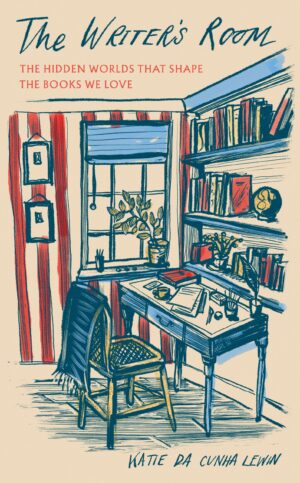
When asked to conjure a mental image of writers at work, what do we see? Perhaps a book-lined study, tasteful art pieces, the writer toiling away at their desk, a solitary soul summoning the magic. The Writer’s Room by Katie da Cunha Lewin takes us on an absorbing and wide-ranging journey, beyond the rarified spaces of the preserved writer’s house and ‘exit through the gift shop’ vibe to the aspiring novelist typing into their phone on the bus to their day job, the harassed parent scribbling away between baby’s feeds, and the new writing spaces carved out by and for the 21st century writer.
In her reflections on our cultural fascination with the writer’s room, Da Cunha Lewin begins, appropriately enough, with Virginia Woolf, famously enthusiastic regarding the necessity of a room of one’s own for intellectual pursuits. Relating her visit to Monk’s House, Woolf’s country retreat in Sussex, the author’s expectation is touching. She’s nervous, reverential, hoping to be inspired. Her description of the place is vivid, but alas, there is ‘only the lack of Woolf’, her writing desk behind glass, a staged and unconvincing scene.
Later, Da Cunha Lewin visits Keats House and Charles Dickens Museum in London, her observations here equally applicable. Many of these visitor attractions are carefully curated impressions, not literal reconstructions, leaving us searching for authenticity (interestingly, in their bid to deliver this authenticity, whilst relocating Roald Dahl’s famous writing shed, conservators vacuumed up its decades of dust, sterilised and re-sprinkled it).
‘I can’t help but read this as a way of putting Dahl’s body back into the room, even if only through years of discarded skin cells.’
Da Cunha Lewin wonders if we are searching for evidence of genius when we visit these places or some sort of psychic imprint, ‘…the leftovers of words or ideas secreted behind the picture frames or even in the very walls themselves.’
Nowhere is this psychic imprint theory more evident than in the auctioning of the late Joan Didion’s possessions in 2022. Her furniture, books, even unused Moleskine notebooks became available for public consumption, imbuing them with a sense of her ownership. Not content with merely visiting a writer’s home, we want her stationery too, perhaps ‘any potential words written into them could feel suffused with hers’.
Wonderfully researched, thought-provoking and immersive, The Writer’s Room is particularly strong in the later chapters examining the concept of writers’ spaces in the 21st century.
In these turbulent political and economic times, a lack of affordable housing, precarious employment, and the high cost of living can make the idea of a personal writing room seem impossible. A champion of libraries, Da Cunha Lewin is also evangelical about more modern inventions: the Mothers Who Write network, with its Zoom writing sessions and in-person retreats, online writing salons, the proliferation of independent local cafés (as long as you don’t sit nursing a single coffee all morning!). We can and should reimagine our creative spaces.
A great gift for the bibliophiles and aspiring writers in your life.